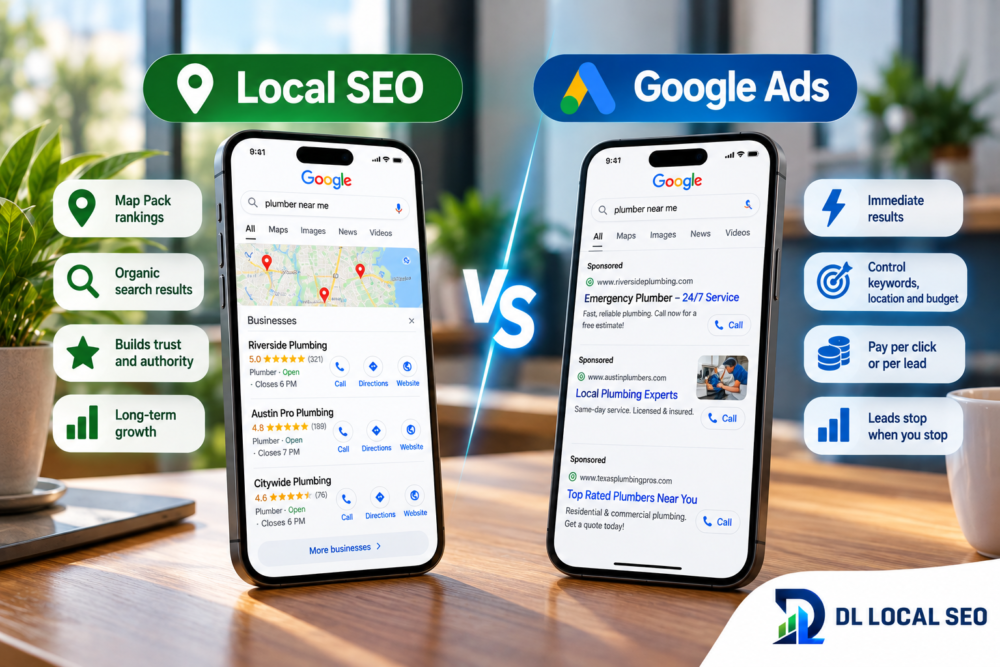
Local SEO vs Google Ads: Which Brings More Customers for Less?
Quick answer
There are two ways to get customers from Google: earn them with local SEO — your Google Business Profile in the Map Pack plus your website in organic results — or rent them with Google Ads, meaning pay-per-click search ads and pay-per-lead Local Services Ads. If you plan to serve the same area for more than a year and can wait 3–6 months, put most of your budget into local SEO: in BrightLocal’s click study about 73% of clicks on local service searches went to the Map Pack and organic results, and a $699-a-month SEO plan beats Google Ads for a home-service business once it brings about 8 leads a month, because the 2026 average Google Ads cost per lead in home services is $90.92. Google Ads has real advantages: calls can start within a day, you control keywords, ZIP codes and hours, and in cheap-lead industries such as auto repair ($29.96 per lead) it is hard to beat. Its drawbacks are just as concrete: you pay for every click, click prices rose in 87% of industries in LocalIQ’s latest benchmarks, and leads stop the day you stop paying. For most small businesses the best answer is both, in sequence: ads for emergency and high-margin keywords while SEO ramps up, then budget shifts to SEO as Map Pack calls grow. Before you decide, write down your average job value and the share of leads you close — together they tell you the most you can afford to pay per lead.
Where Do Customers Click on a Local Google Search?
Most clicks on a local search go to results you can’t pay for: in BrightLocal’s click study, the Map Pack took 28.8% and organic results 43.9%, while Local Services Ads and search ads together took about 25%.
Type “plumber near me” or “dentist in Austin” and Google shows up to four different kinds of results on one screen. Two of them are bought, two are earned, and each is won in a different way:
- Local Services Ads — the boxes at the very top with a “Google Screened” or “Google Guaranteed” badge. You pay per lead (a call, message or booking), not per click, and you must pass background, license and insurance checks first.
- Search ads — text ads marked “Sponsored.” You bid on keywords and pay each time someone clicks.
- The Map Pack — three businesses on a map. Google ranks them by relevance, distance and prominence, and prominence is largely your reviews and how complete your Google Business Profile is.
- Organic results — regular website listings. Here your service and city pages compete, which is the work of local SEO and on-page optimization.
The study is from 2018, before AI Overviews, so read it as a direction rather than an exact split today. The pattern it shows still holds: many people skip anything labeled as an ad and click the businesses with the most reviews closest to them. That is why “local SEO vs Google Ads” is really a question of whether you want to rent a quarter of the clicks or compete for the other three quarters.
Local SEO vs Google Ads: Side-by-Side Comparison
Local SEO is cheaper per customer over time and keeps working after you stop paying; Google Ads is faster, easier to control and stops the moment the budget runs out.
| Factor | Local SEO | Google Ads (search ads + Local Services Ads) |
|---|---|---|
| Where you appear | Map Pack (top 3 on Google Maps) and organic results under the ads | “Sponsored” ads above and below organic results; Local Services Ads above everything |
| How you pay | Monthly fee for the work — most small businesses pay $300–$1,500 a month — or your own time; every click is free | Every click (search ads) or every lead (LSA), plus management, usually 10–20% of ad spend or a flat fee |
| Typical cost per lead | No per-lead charge: monthly fee ÷ leads, so it falls as rankings grow | $90.92 home services, $131.63 legal, $72.97 dental, $29.96 auto repair (LocalIQ); LSA in home services often $35–$60 (WebFX) |
| Time to first leads | Map Pack often moves in 1–3 months; competitive organic rankings in 3–6+ months | Same day for search ads; LSA only after verification, which can take weeks |
| Share of local clicks | About 73% (Map Pack + organic) | About 25% (LSA + search ads) |
| When you stop paying | Rankings, reviews and pages keep bringing calls for months; decline is gradual | Leads stop the same day |
| Price trend | Unit cost falls as the same work ranks for more searches | Average CPC $5.42, with increases in 87% of industries |
| Control | Low: Google decides rankings; you influence them | High: keywords, ZIP codes, hours, devices and budget, changeable in minutes |
| What you own afterward | Your profile, reviews, pages and links | Account history and data only |
| Effect of AI Overviews | Profile, reviews and pages feed AI answers; cited brands got 35% more organic clicks (Seer) | Paid CTR on queries with AI Overviews fell 68% in 15 months (Seer) |
| Biggest risk | Slow start; suspension if done with spam tactics | Paying for irrelevant clicks; competitors pushing bids up |
| Best for | Businesses staying in one area 1+ year, repeat or high-ticket work | New businesses, emergencies, short promotions, testing new services or cities |
Not sure where your budget should go?
Book a free 15-minute call or a free analysis of your 3 priority pages. Bring your Google Ads numbers if you have them — we’ll show what the same money could do in local SEO.
What Does Each Really Cost per Customer?
Compare cost per booked job, not cost per click: cost per lead equals what you spend divided by leads, and cost per customer equals cost per lead divided by the share of leads you close.
A click is not a customer. In LocalIQ’s 2026 search advertising benchmarks, the average click costs $5.42 and about 8% of clicks turn into a lead. The table below turns those averages into the numbers a business owner actually decides on. The last column is the most useful one: it shows how many leads a month a $699 local SEO plan has to bring before it is cheaper than buying the same leads with ads.
| Industry | Avg. cost per click | Avg. cost per lead | Ad spend for 20 leads/month | Cost per customer at 40% close rate | Leads/month for $699 SEO to beat ads |
|---|---|---|---|---|---|
| Home services & home improvement | $8.33 | $90.92 | $1,818 | $227 | 8 |
| Lawyers & legal services | $9.87 | $131.63 | $2,633 | $329 | 6 |
| Real estate | $3.22 | $102.51 | $2,050 | $256 | 7 |
| Dentists | $8.00 | $72.97 | $1,459 | $182 | 10 |
| Health & fitness | $6.17 | $67.36 | $1,347 | $168 | 11 |
| Physicians & surgeons | $4.76 | $40.04 | $801 | $100 | 18 |
| Beauty & personal care | $4.62 | $39.25 | $785 | $98 | 18 |
| Auto repair & service | $4.35 | $29.96 | $599 | $75 | 24 |
Cost per click and cost per lead from LocalIQ’s 2026 benchmarks. Spend, cost per customer and break-even leads are our calculations from those averages; your own numbers will differ by city and competition.
Two things stand out. In expensive-click industries — legal, home services, real estate — a local SEO plan pays for itself with fewer than ten leads a month, which a well-optimized profile in a mid-size city can reach within months. In cheap-click industries such as auto repair, beauty and medical practices, ads stay efficient for longer, and SEO has to deliver 18–24 leads a month to win on price alone. There it wins on something else: those leads don’t stop when you stop paying. Our local SEO ROI calculator lets you run the same math with your own job value and margin.
How Fast Does Each One Bring Calls?
Google Ads can bring calls on day one; local SEO usually starts moving the Map Pack in 1–3 months and website rankings in 3–6 months, after which its cost per lead keeps falling while ads stay flat.
Speed is where Google Ads clearly wins. A search campaign can show within hours of approval, which is why ads are the right tool for a new location, a slow month or a service you want to test. SEO is slower because Google needs to trust your business: in Ahrefs’ ranking study, only 5.7% of new pages reached the top 10 within a year, and the ones that did took 61–182 days. The Map Pack usually responds faster than the website, because profile fixes, categories, photos and new reviews are picked up within weeks.
The chart explains why owners who judge SEO in month two give up too early: at that point it really is more expensive than ads. The turn usually comes between months 4 and 9, depending on competition, and from then on every extra ranking lowers the cost per lead without raising the monthly fee.
How AI Overviews Change the Math
AI Overviews cut clicks on both ads and organic results, but they favor businesses Google already trusts — which makes the assets built by local SEO more valuable, not less.
Seer Interactive’s study of 3,119 queries over 15 months found that when an AI Overview appeared, paid click-through rate fell 68% and organic fell 61%. Brands cited inside the AI Overview did noticeably better: 35% more organic clicks and 91% more paid clicks than brands that weren’t cited. For a local business, those citations come from the same places as Map Pack rankings — a complete profile, consistent listings, reviews and clear service pages. Google’s AI Mode and assistants such as ChatGPT pull from that data when they recommend a plumber or a dentist. We explain how this works in our guide to AI Overviews and AI Mode for local businesses and in our AI visibility service.
Paying for clicks every month?
Send us your website and the keywords you bid on. We’ll check which of them you could win in the Map Pack instead — free, no contract.
Which Should You Choose? A Decision Table by Situation
Choose by your situation, not by the channel: new and urgent businesses start with ads, established businesses in one area lean on local SEO, and most do best with a planned mix that shifts over 6–12 months.
| Your situation | Lean toward | Suggested split, first 6 months | Why |
|---|---|---|---|
| Brand-new business, few or no reviews | Ads first, SEO set up in parallel | 70% ads / 30% SEO | You need calls now, and a new profile has no reviews to compete with in the Map Pack |
| Emergency trades: plumbing, locksmith, towing, HVAC repair | Both | 50% / 50%, ads limited to emergency keywords and hours | People call the first credible result; the LSA badge and Map Pack catch most of those calls |
| High-ticket work: roofing, remodeling, law, implants | Local SEO + Local Services Ads | 60% SEO / 40% ads | Buyers compare reviews and pages before calling; one extra job can pay for a year of SEO |
| Seasonal demand: HVAC, landscaping, pools, tax prep | SEO year-round, ads in peak months | SEO steady; ads only in season | Rankings built off-season are ready when demand starts; ads cover the spike |
| Top 3 competitors have 300+ reviews each | Ads now, SEO for suburbs and specific services | 60% ads / 40% SEO for 6–12 months | The main Map Pack will take time; smaller areas and narrow services rank sooner |
| Total budget under $1,000 a month | Local SEO focused on your Google profile, or LSA only | 100% to one channel | $1,000 buys about 11 home-service leads on ads; profile work keeps paying after the month ends |
| Several locations or a franchise | Both, decided per location | Mature locations lean SEO; new ones start with ads | Each location has its own Map Pack; see our multi-location SEO approach |
The Smart Way to Use Both
Use Google Ads to buy time and data while local SEO matures, then move budget to SEO search by search as your rankings take over.
Ads carry the calls
Run ads on your highest-value services and emergency keywords. Start SEO with the profile, citations, reviews and your top service pages — our local SEO audit shows what to fix first.
Let data steer SEO
Use the ads search terms report to see which phrases turn into booked jobs, and build or improve pages for exactly those. Cut ad keywords where you now appear in the Map Pack.
SEO takes the lead
Keep ads for after-hours, new services and areas you don’t rank in yet. Track total calls: if they hold steady after a cut, the budget is better spent on SEO.
Mistakes that waste money on both channels:
- Broad-match keywords without negatives. “Plumbing jobs” and “DIY drain cleaning” will eat your budget.
- Sending ads to the homepage. A page for the exact service and city converts better and is the same page SEO needs.
- Not tracking calls. Most local leads phone; without call tracking you can’t compare channels.
- Buying “SEO” that is only blog posts. For local results the profile, reviews and service pages matter far more — see our breakdown of what local SEO should cost.
- Switching ads off before SEO is ready. Cut gradually, keyword by keyword, while checking total calls.
Two Example Scenarios
The same budget can point to different answers: in an expensive-click trade SEO wins within months, while in a cheap-click trade ads can stay the main channel.
Illustrative example · Home services
A plumber with $1,500 a month
All on Google Ads at about $91 per lead, that budget buys roughly 16 leads a month — and nothing once it stops.
Split as $699 for local SEO and $800 for ads, the plumber gets about 9 ad leads from day one. If the Map Pack adds 15 calls a month by month six, the same $1,500 brings about 24 leads at roughly $62 each, and the SEO share keeps working if ads are paused. See how we approach SEO for plumbers.
Illustrative example · Auto repair
A repair shop with $700 a month
At about $30 per lead, $700 in ads buys around 23 leads a month — a $699 SEO plan would need 24 leads to match it on price.
Here the better move is ads as the main channel, plus the low-cost basics of local SEO: a complete profile, steady review requests and correct listings. That protects the shop if click prices rise. More in our guide to SEO for auto repair shops.
Is SEO Better Than PPC? Our Verdict
For most local service businesses, yes — SEO is better than PPC over any period longer than about six months, while PPC is the better tool for the first months, for emergencies and for cheap-lead industries.
Ads are a tap: open it and calls flow, close it and they stop. Local SEO is closer to a well: it takes time to dig, but then it keeps giving at a fixed cost, and Google states that buying ads does not change your organic rankings either way. If you are deciding today, start by checking what your profile and pages are missing, then set a 6-month plan with both channels and a clear date to review the split. Our plans are listed with prices on the industry pages and start at $399 a month, month-to-month.
Local SEO vs Google Ads: FAQ
Is local SEO better than Google Ads?
For most local service businesses that plan to stay in one area for more than a year, yes. Around 73% of clicks on local service searches go to the Map Pack and organic results, and local SEO keeps producing calls after you stop paying. Google Ads is better when you need calls this week, when you are testing a new service or city, or in industries where leads are cheap, such as auto repair at about $30 per lead.
Is SEO better than PPC for a small business?
SEO usually costs less per customer after 4–9 months, while PPC wins on speed and control. A $699-a-month local SEO plan beats Google Ads for a home-service business once it brings about 8 leads a month, because the 2026 average Google Ads cost per lead in home services is $90.92. Most small businesses do best running both for the first six months and then shifting budget toward SEO.
How much should a small business spend on Google Ads vs SEO?
A practical start is 60–70% of the budget on ads and 30–40% on local SEO for the first three months, moving to about 70% SEO by months 7–12 as Map Pack calls grow. With less than $1,000 a month in total, put it into local SEO focused on your Google Business Profile, or into Local Services Ads only, rather than spreading it thin.
How long does local SEO take compared with Google Ads?
Google Ads can bring calls the same day the campaign is approved. Local SEO usually moves your Google Business Profile in the Map Pack within 1–3 months and competitive website rankings within 3–6 months or longer. In Ahrefs’ study, only 5.7% of new pages reached Google’s top 10 within a year, and those that did took 61–182 days.
Can I stop Google Ads once my SEO is working?
You can cut most of it. Keep ads for emergency keywords, after-hours searches, new services and areas where you don’t rank yet, and pause ads on searches where you already appear in the Map Pack and top organic results — then check whether total calls stay level for 30 days.
Do Google Ads help my SEO rankings?
No. Google has repeatedly stated that buying ads does not improve, and stopping ads does not hurt, your organic rankings or Map Pack position. Ads help SEO only indirectly: the search terms report shows exactly which phrases bring calls, which tells you which service pages to build.
Find Out Which One Will Pay Off for You
Get a free, personalized video walkthrough of your Google Business Profile and website next to two or three local competitors, with a clear recommendation on how to split your budget between local SEO and Google Ads. Month-to-month plans, and you keep ownership of every account.
Explore our services: Google Business Profile Optimization · Local SEO · On-Page SEO · Industries we serve
Sources: LocalIQ — Search advertising benchmarks 2026; BrightLocal — Local Services Ads click study; Seer Interactive — AI Overviews impact on CTR; Ahrefs — How long does it take to rank; WebFX — Google Local Services Ads cost; Search Engine Roundtable — Google on ads and organic rankings.