Local Citations: What They Are and Where to List Your Business
Quick answer
Local citations are online mentions of your business’s name, address and phone number (NAP) on other websites — map platforms, directories, data aggregators, industry sites and local publications. They help Google, Apple, Bing and AI tools confirm that your business is real and that its details are correct. Start with Google Business Profile, Apple Business Connect and Bing Places, then Yelp, Facebook, BBB and the main data aggregators, followed by the leading directories in your industry and a few genuinely local sites. Consistency matters more than volume: one accurate set of details everywhere beats hundreds of messy listings.
What Is a Local Citation?
A local citation is any online mention of your business’s core details — name, address and phone number, usually called NAP — and often your website, hours, categories and description.
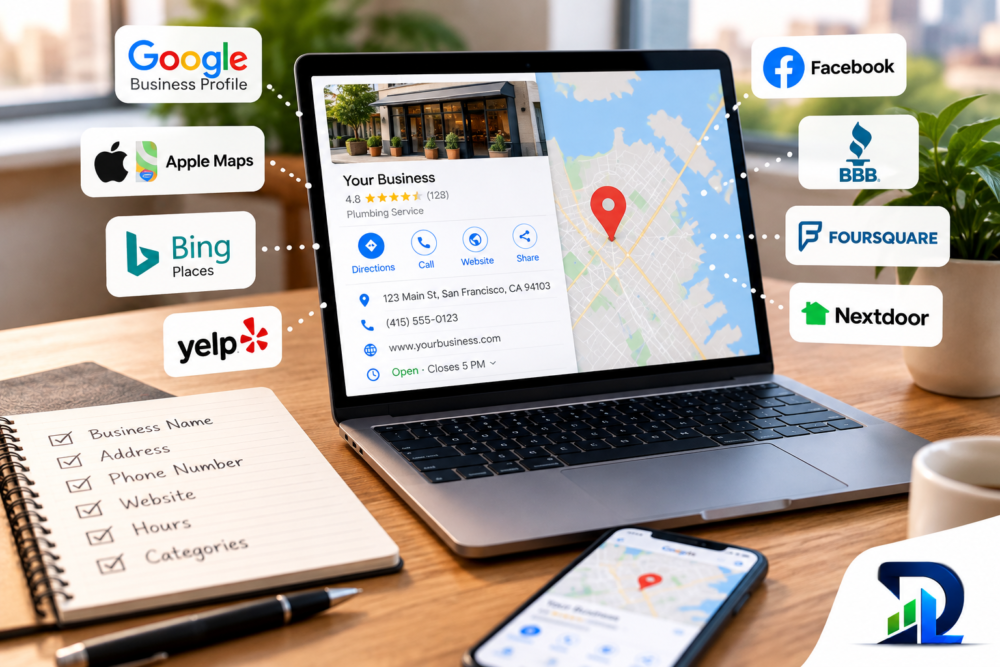
Citations come in two forms. Structured citations live in organized business listings: Google Business Profile, Apple Maps, Bing Places, Yelp, the Better Business Bureau and industry directories. Unstructured citations are mentions inside regular content — a local news story about your shop, a blog review, a sponsor list on a youth sports website, an event page. Both tell search engines and AI systems the same thing: this business exists, it’s here, and this is how to reach it.
Why Do Local Citations Still Matter?
Citations matter less as a raw ranking lever than they did a decade ago, but they remain a trust foundation: inconsistent or missing listings can hold back rankings, confuse customers and feed wrong details into maps and AI answers.
- Verification. Search engines cross-check your details across many sources; agreement builds confidence in your Google Business Profile.
- Real customers. Apple Maps, Yelp, Nextdoor and industry directories send calls and visits on their own.
- AI search. AI assistants and Google’s AI features draw on the same web of listings, so consistent data helps them describe you correctly. Read more in our guide to Google AI Overviews and AI Mode for local businesses.
- Damage control. Old addresses and disconnected numbers on popular sites send customers to the wrong place — and they leave.
Industry research such as Whitespark’s Local Search Ranking Factors survey consistently places citations behind Google Business Profile signals, reviews and on-page factors — but still as part of the foundation that the other signals rely on.
What Is NAP Consistency and Why Does It Matter?
NAP consistency means your business name, address and phone number are written the same way on every listing. Inconsistent details can create duplicate listings, split your reviews and make search engines less certain which information is correct.
| Problem | Example | Fix |
|---|---|---|
| Old business name | “Smith Plumbing” vs. “Smith Plumbing & Drain” | Update every listing to your current legal or trading name |
| Missing suite or unit | “120 Main St” vs. “120 Main St, Suite 4” | Use the full address the same way everywhere |
| Multiple phone numbers | Old landline on Yelp, mobile on Google | Pick one primary local number; list tracking numbers only as additional |
| Moved location | Previous address still on directories | Update or mark the old listing as moved — don’t just ignore it |
| Duplicate listings | Two Yelp pages for one business | Request a merge or closure of the duplicate |
| Keyword-stuffed name | “Smith Plumbing Best Plumber Dallas” | Use your real name only — keyword stuffing breaks platform guidelines |
For service-area businesses that don’t serve customers at their address, hide the street address on platforms that allow it and keep the city and service areas consistent. Follow Google’s guidelines for representing your business as your baseline — other platforms rarely contradict it.
Not sure how clean your business listings are?
Get a free 15-minute consultation or a free analysis of your 3 priority pages. We’ll spot inconsistent names, addresses and phone numbers, duplicates and missing listings that hold your Map Pack rankings back.
Where Should You List Your Business?
List your business in order of impact: the core map platforms first, then major directories and data aggregators, then the leading directories in your industry, and finally a handful of genuinely local and community websites.
| Platform | Why it matters | Cost |
|---|---|---|
| Google Business Profile | Map Pack, Google Maps, AI features | Free |
| Apple Business Connect | Apple Maps, Siri, iPhone and CarPlay searches | Free |
| Bing Places | Bing, Copilot and other services using Bing data | Free |
| Yelp | High-traffic reviews; data reused by other services | Free listing; ads optional |
| Facebook Page | Local discovery, recommendations, reviews | Free |
| Better Business Bureau | Trust signal for home services and professional services | Free listing; accreditation paid |
| Nextdoor | Neighbor recommendations | Free business page |
| Foursquare | Location data used by many apps and services | Free |
Claim Apple Business Connect and Bing Places even if you rarely use them yourself — many customers do, and Bing data also reaches other assistants and apps.
Data aggregators
Data aggregators collect business information and distribute it to apps, navigation systems, directories and other platforms. In the US, the main ones include Data Axle and Localeze, alongside Foursquare’s location data. Correcting your details at the aggregator level helps fix many downstream listings at once, although changes can take one to three months to spread.
Which Industry Directories Matter for Your Business?
Industry directories carry extra weight because they’re relevant to what you do and often rank on page one for your services. Pick the leading few in your field rather than every niche site you can find.
| Industry | Examples |
|---|---|
| Home services | Angi, HomeAdvisor, Houzz, Thumbtack, Porch |
| Health and dental | Healthgrades, Zocdoc, WebMD Care, Vitals |
| Legal | Avvo, Justia, FindLaw, Martindale-Hubbell |
| Restaurants and hospitality | TripAdvisor, OpenTable, Uber Eats, DoorDash |
| Automotive | Cars.com, CarGurus, RepairPal |
| Real estate | Zillow, Realtor.com, Homes.com |
Then add genuinely local sources: your chamber of commerce, business associations, local news sites, sponsorship pages, community event listings and neighborhood guides. These are hard for competitors to copy and are often the most trusted citations you’ll have.
How to Build and Clean Up Local Citations: Step by Step
Decide on your official business details first, audit what already exists, fix the most important listings and duplicates, then add new citations tier by tier and monitor them over time.
Lock your official NAP
Write down the exact name, address, phone, website, hours, categories and a 750-character description. Every listing uses this master record.
Audit what already exists
Search your business name, old names, current and old phone numbers and old addresses. List every listing, its status and any wrong details or duplicates.
Fix, then build
Correct the core platforms and duplicates first, update data aggregators, then add industry and local citations. Re-check key listings every quarter.
A local SEO audit gives you this inventory without the manual searching, and our citation building service handles the claiming, cleanup and ongoing monitoring.
Want your citations built and cleaned up for you?
Pick a free 15-minute consultation or a free analysis of your 3 priority pages — we’ll show you which listings to fix first and which directories are worth your time in your industry.
Manual Citation Building vs. Tools and Services
Manual building gives you full control of every account; tools speed up distribution and monitoring. Most businesses do best with a mix: claim the core platforms yourself and use a tool or service for the long tail.
| Approach | Pros | Watch out for |
|---|---|---|
| Manual (in-house) | You own every login; no ongoing fees | Time-consuming; easy to make inconsistent entries |
| One-time citation service | Fast, consistent submissions; you keep the listings | Check which sites are included and who owns logins |
| Subscription listing networks | Instant updates and monitoring across many sites | Some changes can revert if you cancel the subscription |
Common Citation Mistakes to Avoid
The costliest mistakes are inconsistency, ignored duplicates and chasing volume over quality.
- Buying hundreds of low-quality listings. Spammy directories add little and can be hard to clean up later.
- Leaving duplicates alone. Two listings for one business split reviews and confuse search engines.
- Using a tracking number as the main phone. Keep one primary local number consistent; add tracking numbers only where the platform allows an additional number.
- Forgetting old addresses after a move. Update every listing, including aggregators.
- Different business names across platforms. Pick one version and stick to it.
- Not saving logins. Keep every account under a company email you control.
What Does a Citation Cleanup Look Like in Practice?
The scenarios below are illustrative, built from common local-business situations — not results from specific DL Local SEO clients.
Scenario 1
A clinic that moved across town
Before: the new address on Google, the old one on Yelp, Healthgrades and several data sources; patients occasionally arrived at the old building.
What changed: a full audit, updates at the aggregator level, corrected industry listings and closed duplicates.
The typical result: consistent details across platforms within a few months and fewer lost patient visits.
Scenario 2
A home-service company with three phone numbers
Before: a different number on almost every directory and two Google profiles.
What changed: one primary number everywhere, tracking numbers moved to additional-phone fields, the duplicate profile merged.
The typical result: cleaner call data and a single, stronger Google Business Profile.
Citations work best alongside a strong Google Business Profile, a steady flow of reviews and well-built service pages — the core of our local SEO service. If you also want to show up in AI-generated answers, see our AI visibility SEO service.
Local Citations: Frequently Asked Questions
What is a local citation?
A local citation is any online mention of your business’s name, address and phone number (NAP), often with your website, hours and categories. Structured citations appear in business directories and map platforms such as Google, Apple Maps, Bing, Yelp and industry directories; unstructured citations are mentions in news articles, blogs or community websites.
Do local citations still matter for SEO?
Yes, but differently than a few years ago. Citations are no longer a volume game; their main job is to confirm that your business is real and that its details are consistent everywhere. Consistent, accurate listings on the platforms that matter support Map Pack rankings, help AI tools describe your business correctly, and send real customers through directories like Yelp, Apple Maps and industry sites.
How many citations does a local business need?
There is no magic number. Most local businesses benefit from accurate listings on the core platforms, the major directories, the main data aggregators in their country, the leading directories for their industry and a handful of genuinely local sites. Quality, accuracy and relevance matter far more than reaching hundreds of listings.
What is NAP consistency?
NAP consistency means your business name, address and phone number appear the same way on every listing. Small differences — an old phone number, a missing suite number, a former business name — can create duplicate listings and make it harder for search engines to trust your information.
Should I use a citation tool or build citations manually?
Both work. Tools can distribute data to many listings quickly and monitor changes, but some subscription services only keep listings updated while you pay. Manual building takes longer but gives you full ownership of each account. Many businesses combine manual claiming of the most important platforms with a tool or service for the rest.
How long do citations take to affect rankings?
New and corrected listings are often visible within days to a few weeks, while data aggregators can take one to three months to push updates across their partners. Ranking improvements depend on how inconsistent your data was before and on your other local SEO signals.
Find Out Where Your Listings Are Hurting You
Get a free, personalized video walkthrough of your Google Business Profile and your most important citations, compared with two or three competitors in your area — including inconsistent details, duplicates and the directories you’re missing. No obligation and no long-term contract.
Explore our services: Google Business Profile Optimization · Local SEO · On-Page SEO · Industries we serve
Sources: Google Business Profile guidelines; Apple Business Connect; Bing Places for Business; Whitespark Local Search Ranking Factors.
2 thoughts on “Local Citations: What They Are”