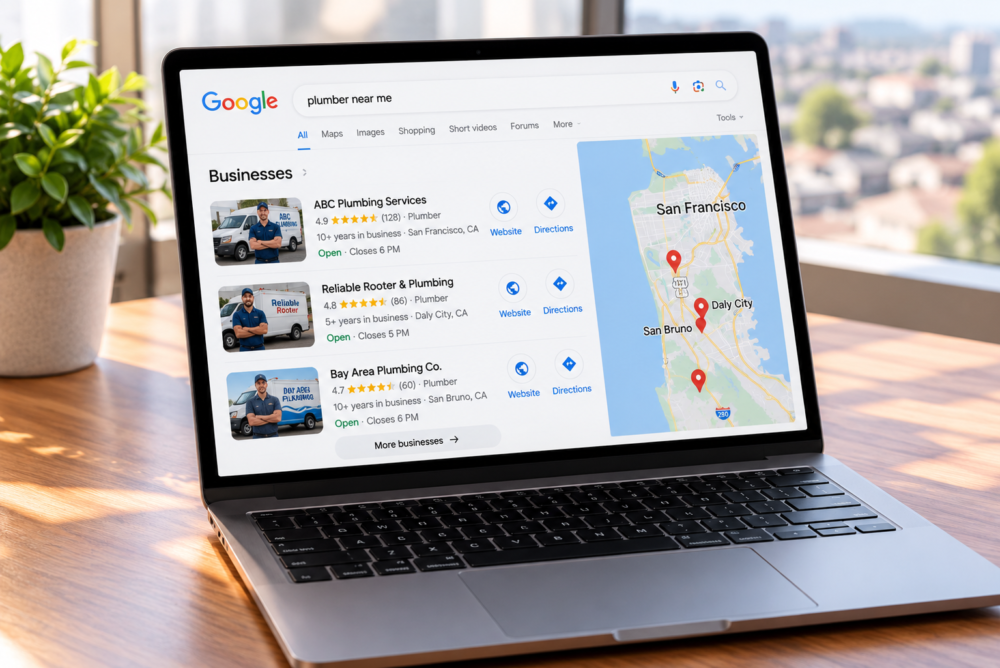
Is Local SEO Worth It for Small Businesses? The Real ROI Math
Quick answer
Local SEO is worth it for most small businesses that serve a local area and have customers searching for them on Google. The math is simple: if the extra customers it brings produce more gross profit than the monthly cost, it pays for itself. For a service business with a $350 average job and a 50% margin, a $699 plan breaks even at four new customers a month — and because rankings, reviews and your Google Business Profile keep working, the return usually grows over time. It’s less worth it if there’s little search demand, you can’t take on more work, or you need results in days.
How Do You Calculate Local SEO ROI?
Local SEO ROI is the gross profit from new customers it brings, minus what you pay for it, divided by what you pay for it. If the result is above zero, it’s paying for itself.
ROI = (new customers × average job value × profit margin − monthly SEO cost) ÷ monthly SEO cost × 100
Notice what drives the result: not rankings or traffic on their own, but how many searchers turn into paying customers and how much each one is worth. That’s why the same $699 plan can be a bargain for a roofer and a stretch for a coffee shop.
Local SEO ROI Calculator
Plug in your own numbers to see your break-even point and the return you could expect from a realistic number of extra leads.
Local SEO ROI calculator
Enter your own numbers to see how many new customers local SEO needs to bring to pay for itself.
Estimates only. Real results depend on your market, competition and how well you handle leads.
Not sure what to enter for “extra leads”? Look at your Google Business Profile performance data for calls and website clicks, or ask us to estimate search demand for your services and towns.
Want us to run the ROI math for your business?
Get a free 15-minute consultation or a free analysis of your 3 priority pages. We’ll estimate search demand in your area, what your competitors rank for, and how many jobs local SEO would need to bring to pay for itself.
Is Local SEO Worth It for Your Industry?
The higher your average job value and the more people search for your service locally, the faster local SEO pays off.
| Industry | Example average job | Example margin | New customers to break even |
|---|---|---|---|
| Plumber or electrician | $350 | 50% | 4 per month |
| Roofer | $9,000 | 25% | 1 every 3 months |
| HVAC contractor | $600 | 40% | 3 per month |
| Dentist (new patient value) | $1,200 | 40% | 2 per month |
| Personal injury law firm | $5,000+ fee | high | well under 1 per month |
| Hair salon | $60 | 60% | about 20 per month |
These examples use assumed values to show the math — not results from specific DL Local SEO clients. Use your own numbers in the calculator above.
High-ticket trades often see the clearest return. Our guides on plumbing marketing, electrician marketing and getting roofing customers without buying leads show how local SEO fits alongside other channels.
How Long Does Local SEO Take to Pay Off?
Expect a slower first few months while your profile, pages and citations build trust, then compounding returns. Many small businesses break even between month three and month nine.
Foundation
Google Business Profile, citations, key service pages and review requests. Map visibility often improves first.
Momentum
More keywords rank, calls from Maps and the website grow, and many businesses cross break-even.
Compounding
Reviews, authority and content keep working; the cost stays flat while the lead flow keeps climbing.
Local SEO vs. Google Ads: Which Has Better ROI?
Ads win on speed, local SEO wins on cost per lead over time. The best return usually comes from using both for different jobs.
| Factor | Local SEO | Google Ads / Local Services Ads |
|---|---|---|
| Speed | Weeks to months | Days |
| How you pay | Fixed monthly fee or your time | Per click or per lead |
| When you stop paying | Rankings and reviews keep working | Leads stop immediately |
| Trust | Organic results and reviews feel earned | Clearly labeled as ads |
| Best for | Long-term, lower cost per lead | Quick wins, seasonal pushes, testing |
Also worth considering: AI-generated answers increasingly summarize local businesses from the same signals local SEO builds — see what AI Overviews and AI Mode mean for local businesses.
Is local SEO worth it in your market? Let’s find out.
Pick a free 15-minute consultation or a free analysis of your 3 priority pages — we’ll give you an honest answer, even if the answer is “not yet.”
When Is Local SEO Not Worth It?
Local SEO is a poor investment when there’s no demand to capture, no capacity to serve it or no patience to wait for it.
- Nobody searches for your service locally. Check search demand before you invest.
- You’re already fully booked. More leads won’t help until you can serve them — or until you want to raise prices.
- You need results within days. Use ads for that, and start local SEO in parallel.
- Reviews or service quality are a problem. More visibility will expose it; fix the business first and see our guide to responding to negative reviews.
- Your average sale is very small and repeat business is rare. The math may not work at agency prices — a DIY approach can make more sense.
How to Make Local SEO Worth More
- Answer every call fast. Missed calls are missed ROI.
- Prioritize high-value services. Build pages for the jobs with the best margins first.
- Keep reviews coming. Fresh, detailed reviews lift both rankings and conversion.
- Fix your listings. Consistent citations support the Map Pack — see our guide to local citations.
- Track everything. You can’t improve ROI you can’t see.
How to Measure Local SEO ROI
Track leads by source, connect them to booked jobs and revenue, and compare that profit with what you spend every month.
| Metric | Where to find it | Why it matters |
|---|---|---|
| Calls and direction requests | Google Business Profile performance | Direct signal of Maps-driven demand |
| Website leads by source | Analytics, call tracking, form tracking | Separates SEO leads from ads and referrals |
| Booked jobs from SEO | Your CRM or job software | Turns leads into revenue |
| Rankings for money keywords | Rank tracking by city | Leading indicator of future leads |
| Review count and rating | Google Business Profile | Drives trust and conversion |
Our local SEO service includes monthly reporting on these numbers, and a local SEO audit is a low-cost way to see the gaps before committing. Wondering about budget? Our breakdown of how much local SEO costs in 2026 covers pricing tiers, and plans start at $399 per month.
Is Local SEO Worth It? Frequently Asked Questions
Is local SEO worth it for a small business?
For most small businesses that serve a local area and have customers searching on Google, yes. Local SEO is worth it when the extra customers it brings generate more gross profit than it costs — which, for a service business with an average job of a few hundred dollars, often means just two to five new customers a month. It is less worth it if there’s little search demand, you can’t handle more work, or you need results within weeks.
What is a good ROI for local SEO?
Any return above 0% means local SEO is paying for itself, but many businesses aim for at least 2–3× their monthly investment in gross profit once the campaign matures. Because rankings and reviews keep working, the return usually grows over time rather than staying flat.
How long does local SEO take to pay off?
Google Business Profile improvements can bring more calls within weeks, while website rankings in competitive markets usually take three to six months. Many small businesses reach break-even somewhere between month three and month nine, depending on competition and starting point.
How do I calculate local SEO ROI?
ROI = (gross profit from new customers − SEO cost) ÷ SEO cost × 100. Track new leads by source with call tracking and forms, count how many become customers, multiply by average job value and profit margin, then compare with what you spent.
Is local SEO better than Google Ads?
They do different jobs. Ads bring leads immediately but stop the moment you stop paying; local SEO takes longer but keeps producing calls without paying per click. Many businesses use ads for quick wins while local SEO builds a cheaper long-term lead source.
When is local SEO not worth it?
When nobody searches for your service in your area, when you’re already fully booked and can’t take more work, when you need results in days, or when poor reviews and service problems would turn new traffic away. Fixing the business first often delivers a better return.
How much revenue can local SEO generate?
It depends on search demand, competition and your conversion rate. A useful way to estimate it is to multiply the extra leads you can realistically win by your close rate and average job value — the calculator in this article does that for you.
Get Your Local SEO ROI Estimate
Get a free, personalized video walkthrough of your Google Business Profile and website compared with two or three local competitors — plus a realistic estimate of the calls and revenue local SEO could add for your business. No obligation and no long-term contract.
Explore our services: Google Business Profile Optimization · Local SEO · On-Page SEO · Industries we serve
Sources: Ahrefs — SEO pricing survey; Google Business Profile Help — performance insights. ROI examples use illustrative assumptions.