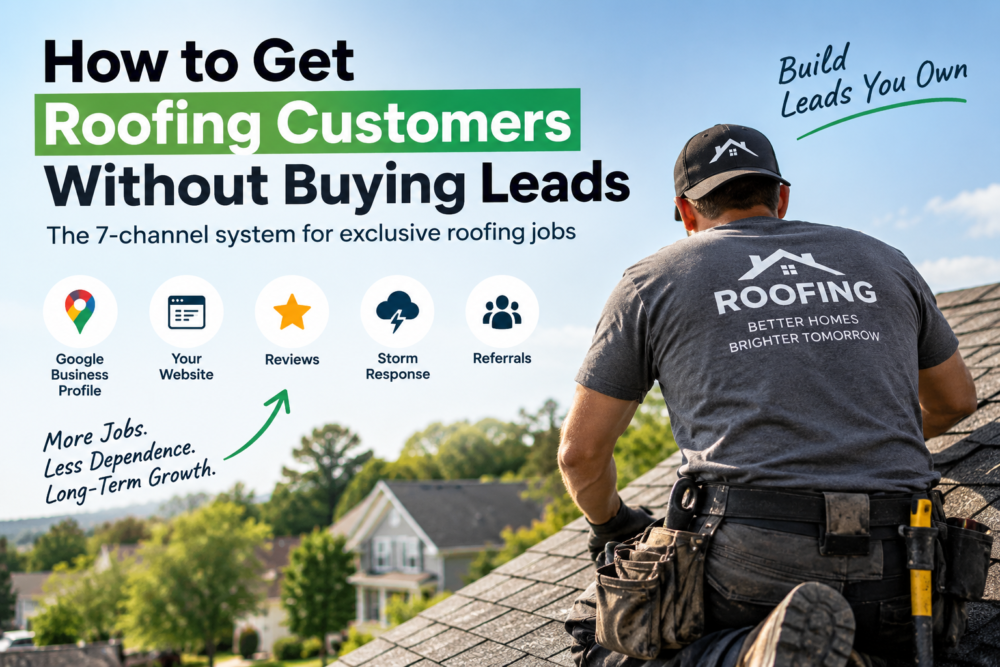
Roofing Leads: How to Get Roofing Customers Without Buying Leads
Quick answer
To get roofing customers without buying leads, build lead channels you own: an optimized Google Business Profile that ranks in the Map Pack, a dedicated page for every roofing service and city you serve, a steady review engine, a storm-response plan, homeowner-focused cost and insurance content, and a referral network of realtors, inspectors and property managers. These leads are exclusive to you, close at higher rates than shared leads, and keep coming after you stop paying for them.
What Does It Really Cost to Buy Roofing Leads?
Shared roofing leads from marketplaces like Angi and HomeAdvisor typically cost $40–$120 each in 2026, but because the same homeowner is sold to three to eight roofers, the real cost per signed job often lands between $500 and $1,250 or more. Published 2026 benchmarks put close rates on shared leads at roughly 8–20%, compared with 25–35% for exclusive leads.
The number that matters is cost per booked job, not cost per lead. Divide what you pay per lead by your close rate. A $75 shared lead that closes 10% of the time costs you $750 per job. A $200 exclusive lead that closes 35% of the time costs about $571 per job — cheaper where it counts, even though the sticker price is almost three times higher.
Bought leads also rent you a customer you never own. The platform controls the relationship, sets the price, and can sell the same homeowner to your competitors again next time they need a gutter, a skylight or a new roof. The lead-selling model has also drawn regulatory scrutiny: in 2023 the FTC finalized an order requiring HomeAdvisor to pay up to $7.2 million over deceptive claims about the quality and source of the leads it sold to contractors.
You can usually tell when a roofing company has become too dependent on bought leads. Watch for these warning signs:
- One platform drives most of your work. If more than half of your booked jobs come from a single paid source, a price increase or an algorithm change can empty your schedule overnight.
- You win jobs by calling first, not by being chosen. When the homeowner picks whoever answers fastest or quotes lowest, you're competing on price instead of reputation.
- Your close rate on platform leads is under 15%. At that rate, most of your lead budget pays for conversations that go to someone else.
- You don't appear in the Google Map Pack in your own city. Search "roof repair" plus your town from a phone. If you aren't in the top three map results, homeowners are calling the roofers who are.
- A slow month on the platform means a slow month for your crews. Without owned channels, you have no way to turn demand back on.
Which Roofing Lead Sources Deliver the Best Cost per Job?
Referrals and organic local search (Google Business Profile plus a well-built website) usually deliver the lowest cost per booked roofing job, because the leads are exclusive, the homeowner is already pre-sold by your reviews, and there's no per-lead fee. Shared marketplace leads have the lowest sticker price but often the highest real cost per job.
| Lead source | Typical cost | Exclusive to you? | Typical close rate | Keeps working after you stop paying? | Time to first leads |
|---|---|---|---|---|---|
| Shared marketplaces (Angi, HomeAdvisor, Thumbtack) | $40–$120 per lead + membership fee | No — sold to 3–8 roofers | 8–20% | No | Days |
| Exclusive lead vendors | $90–$200+ per lead | Yes | 25–35% | No | Days |
| Google Local Services Ads | ≈$45–$150 per lead | Yes | Strong — about 44% of qualified calls booked in one 2026 contractor dataset | No | 1–3 weeks |
| Google Ads (pay-per-click) | ≈$125–$300 per lead | Yes | Depends heavily on your landing page | No | Days |
| Google Business Profile + local SEO | Monthly investment, no per-lead fee | Yes | High — inbound and pre-sold by reviews | Yes — compounds over time | Weeks (profile) to 2–6 months (rankings) |
| Referrals and partners | $0–$100 incentive per job | Yes | 50% or higher | Yes | Ongoing |
| Door knocking / canvassing | ≈$3–$5 per door (labor) | Yes | Varies widely by rep and market | No | Immediate |
Ranges compiled from published 2026 roofing lead-cost benchmarks (including 99 Calls, SearchLight Digital, LocaliQ and GhostRep). Your numbers will vary with your market, storm season and how fast you respond.
The pattern is clear: channels you own get cheaper every month, while channels you rent never do. Paid sources can still play a role — Local Services Ads in particular — but they work best as a supplement to owned channels, not a replacement for them.
How Do You Get Roofing Leads Without Buying Them?
You get roofing leads without buying them by building an owned-lead system: seven marketing channels that belong to your company — your Google Business Profile, service pages, reviews, storm plan, homeowner content, referral partners and AI search presence — and send exclusive calls without a per-lead fee. Every finished job feeds the system with new reviews, photos and referrals.
Not sure which lead source is costing you the most?
Get a free 15-minute consultation or a free analysis of your 3 priority pages. We'll show you where your roofing leads are leaking — and what to fix first.
1. Win the Google Map Pack with Your Google Business Profile
Your Google Business Profile is the biggest source of free roofing calls, because the Map Pack — the three map listings at the top of the results — appears for most "roofer near me" and "roof repair [city]" searches, and homeowners call straight from it.
Set your primary category to Roofing contractor and add secondary categories only for services you actually offer, such as gutters or siding. List every service individually — roof replacement, roof repair, storm and hail damage, roof inspections, emergency tarping — each with a short description. Set your service area to the towns you genuinely cover, upload real job photos every week (before-and-after sets perform especially well), and publish a Google post after every major storm.
One rule protects everything else: never add keywords or city names to your business name. "Smith Roofing" is fine; "Smith Roofing – Best Roof Repair Dallas" violates Google's guidelines and is a common trigger for profile suspensions. If you'd rather have this handled for you, our Google Business Profile optimization service covers the full setup, posting and monitoring.
2. Build a Page for Every Roofing Service and Every City You Serve
Homeowners search for a specific job in a specific place — "hail damage roof repair Plano," not "roofing services" — so one generic Services page can't rank for them. A dedicated page for each service and each core city gives Google a precise match and gives the homeowner a reason to call.
Start with the pages that match your highest-value work: roof replacement, roof repair, storm and hail damage, insurance claim assistance, roof inspections, and commercial or flat roofing if you offer it. Then build city pages only for areas you truly serve, and make each one genuinely local: projects you've completed there, photos from those neighborhoods, notes on local permits or HOA requirements, and reviews from customers in that town. Near-identical pages with only the city name swapped are treated as doorway pages and tend to underperform.
Every page should convert, not just rank. Add a tap-to-call button that stays visible on mobile, a short form with a photo upload option, your license and insurance details, manufacturer certifications, warranty terms and financing options. Our on-page SEO service builds and optimizes exactly these pages.
3. Turn Every Finished Roof into a Five-Star Review
Reviews decide which roofer gets the call: 97% of consumers read reviews before choosing a local business, 47% won't use a business with fewer than 20 reviews, and 31% will only use a business rated 4.5 stars or higher, according to BrightLocal's 2026 Local Consumer Review Survey.
The best time to ask is the day the job is finished, while the crew is cleaning up and the homeowner is looking at a brand-new roof. Text a direct link to your review form rather than asking them to search for you, and let them know it helps to mention the work you did and their town — in their own words, never scripted. Reply to every review within a couple of days, especially the critical ones; future customers read your responses as closely as the reviews themselves.
Never buy, fake or filter reviews. The FTC's rule on consumer reviews, in force since October 2024, bans fake reviews and allows civil penalties, and Google can remove reviews and restrict profiles that break its policies. Ethical review generation is part of our local SEO service.
4. Have a Storm-Response Plan Ready Before the Hail Hits
Residential roofing demand spikes in the days after hail and wind storms, and the roofers who are already visible on Google when homeowners start searching win most of those inspections. Preparation, not reaction, is what captures storm work.
Keep storm damage and hail damage pages live all year, so they have time to rank before the season starts. Prepare a Google post and a text message to past customers in advance, so you can publish within hours. Offer a free, no-pressure inspection, add extra phone coverage for the week after a storm, and make your local credentials impossible to miss — your address, years in business and reviews from neighbors. Homeowners are wary of out-of-town storm chasers, and being visibly local is your advantage.
5. Answer the Questions Homeowners Ask Before They Call
Content that answers cost, insurance and repair-versus-replace questions reaches homeowners weeks before they're ready to hire — and the roofer who answered their questions honestly is usually the first one they call.
The topics that attract future customers are predictable: how much a roof replacement costs in your city, whether homeowners insurance covers hail damage in your state, how to tell if a roof needs repair or replacement, how long different roofing materials last in your climate, and metal versus asphalt shingles. Give real price ranges and plain answers, then end each article with a clear next step, such as a free inspection. This kind of content is also exactly what AI assistants quote when homeowners ask them for advice.
6. Build a Referral Network That Sends Jobs Every Month
Referrals are the cheapest roofing leads you can get: they often close at 50% or higher and cost little more than a thank-you incentive, because the homeowner arrives already trusting you.
Reach out to the people who meet homeowners right before they need a roofer: real estate agents (who need pre-listing inspections), home inspectors, property managers and HOAs, insurance agents, and contractors in adjacent trades such as gutters, siding and HVAC who don't do roofs themselves. For past customers, a simple referral card, a thank-you gift and an annual roof check reminder keep you top of mind. One caution: never offer to waive or rebate an insurance deductible to win a job — it's illegal in several states, including Texas.
7. Get Recommended by ChatGPT, Gemini and Google AI Overviews
AI assistants have become a real source of local recommendations: 45% of consumers used AI tools like ChatGPT to find local businesses in 2026, up from 6% a year earlier, according to BrightLocal. Roofers who are consistently described across the web are the ones these tools name.
Keep your business name, address and phone number identical everywhere. Get listed with the Better Business Bureau and in manufacturer contractor locators if you hold a certification. Earn reviews on more than one platform, and make your website easy to quote: clear service areas, warranties, materials, licenses and answers to common questions, marked up with structured data. AI search visibility is part of the services we provide alongside Google Search and Maps.
Want these 7 channels working for your roofing company?
Pick a free 15-minute consultation or a free analysis of your 3 priority pages — service, city or homepage — and get specific fixes, not a generic report.
Why Does Speed-to-Lead Matter So Much for Roofers?
Call every roofing lead back within five minutes. Response speed changes your close rate more than almost any marketing tactic: Harvard Business Review research found that companies contacting leads within an hour were about seven times more likely to qualify them than those who waited even an hour longer — and homeowners with a leaking roof rarely wait at all.
Speed multiplies every channel in the system. Set up missed-call text-back so no caller hits a dead end, use an after-hours answering service during storm season, let homeowners book inspection times online, and ask for photos of the damage so you can triage before you drive out. Owned leads give you a head start here, because they come to you alone — there are no competitors dialing the same number.
Want results this week? These quick wins take less than a day in total:
- Check your Google Business Profile basics. Confirm the primary category is Roofing contractor, the business name contains no extra keywords, and your hours and phone number are correct.
- Upload ten real job photos. Recent before-and-after shots show Google and homeowners that your business is active.
- Text a review link to your last 20 customers. A short, personal message from the owner gets the best response.
- Add a sticky tap-to-call button to your mobile site. Most roofing searches happen on phones, often in a hurry.
- Turn on missed-call text-back. Every unanswered call gets an instant reply instead of going to your competitor.
- Email five local real estate agents. Offer fast pre-listing roof inspections — it's the easiest referral relationship to start.
- Search "roof repair near me" from three neighborhoods. Note who ranks in the Map Pack; those are the competitors your plan has to beat.
What Does a 90-Day Plan to Stop Buying Roofing Leads Look Like?
A realistic 90-day plan fixes your Google Business Profile and tracking in month one, builds service and city pages in month two, and adds storm, content and referral channels in month three — while you keep a reduced paid-lead budget running as a bridge.
Foundations
Audit and rebuild your Google Business Profile, fix name, address and phone consistency across major directories, install call tracking, and launch your review-request routine.
Pages that rank and convert
Publish core service pages, then city pages for your top service areas, each with local projects, photos and reviews. Add mobile tap-to-call and photo-upload forms.
Growth channels
Launch storm and hail pages, publish your first cost and insurance guides, start outreach to realtors and inspectors, and compare cost per booked job by source.
What Does the Switch from Bought to Owned Roofing Leads Look Like?
In a typical switch, a roofer keeps a smaller paid-lead budget running while owned channels ramp up, and within about six months most booked jobs come from Google Maps, the website and referrals — at a fraction of the previous cost per job.
The two examples below are illustrative scenarios built from common roofing-market patterns, not results from specific clients. Your numbers will depend on your market, competition and season.
Scenario 1
Single-crew residential roofer in a mid-size Midwest metro
Before: $3,000 a month on shared leads brought about 40 leads and 4 booked jobs — roughly $750 per job. The company ranked in the Map Pack only for its own name.
What changed: a rebuilt Google Business Profile, six service pages, five genuinely local city pages, and a text-message review routine after every job.
By month six: Map Pack visibility for "roof repair" in the home city and two suburbs, about 22 inbound leads a month and 7 booked jobs from owned channels, plus 3 from a reduced $1,000 platform budget. Blended cost: $1,699 (a $699 SEO plan plus $1,000 in leads) across 10 jobs — about $170 per job instead of $750.
Scenario 2
Two-location roofer in a hail-belt market
Before: storm work depended on door knocking and paid ads, and out-of-town storm chasers were outranking the company in its own neighborhoods after every hailstorm.
What changed: year-round storm and hail damage pages for each service city, a ready-to-publish Google post template, online inspection booking with photo upload, and a text alert to past customers in affected ZIP codes.
After one storm season: the company was visible in the Map Pack within hours of each storm, and the majority of inspection requests came through Google calls and website forms instead of paid clicks — exclusive leads that no one else was calling.
When Does Buying Roofing Leads Still Make Sense?
Buying roofing leads makes sense as a short-term bridge — while your own channels ramp up, when you expand into a new city, or when crews have open slots to fill — but it shouldn't be the main source of your work. If you do pay for leads, Google Local Services Ads are usually the strongest option, because the leads are exclusive and you can dispute ones that don't fit.
Set a simple rule: track cost per booked job for each paid source every month, and cut any source that stays above your target after a fair test. As owned channels grow, shrink the paid budget step by step rather than all at once.
How Do You Measure Whether Your Roofing Marketing Is Working?
Measure cost per booked job by lead source every month — it's the only metric that compares bought and owned roofing leads fairly. Then track the leading indicators that predict it: Map Pack rankings in each service town, calls and direction requests from your Google Business Profile, website form submissions, review count and rating, and close rate by source.
Use call tracking so every call is attributed to the right channel, and review the numbers monthly rather than daily — local SEO builds momentum over weeks, not hours. At DL Local SEO, every plan includes transparent monthly reporting on rankings, traffic and new inquiries, so you always know which channels are paying off.
Roofing Leads: Frequently Asked Questions
What is the best way to get roofing leads without buying them?
The best way is to build owned channels: an optimized Google Business Profile that ranks in the Map Pack, a website with a page for every roofing service and city you serve, a consistent review-request process, storm-response pages, homeowner cost and insurance content, and referral partnerships with realtors, inspectors and property managers.
How long does it take for roofing SEO to generate leads?
Google Business Profile improvements can start influencing calls within a few weeks. Stronger organic rankings and steady lead volume typically build over two to six months, depending on how competitive your market is and how many service areas you target.
Are Angi and HomeAdvisor leads worth it for roofers?
They can fill open slots in the short term, but shared leads are sold to several roofers at once and close at roughly 8–20%, so the real cost per booked job is often $500 or more. Most roofers get a better return by building channels they own and using paid leads only as a supplement.
How many Google reviews does a roofing company need?
Aim for at least 20, since 47% of consumers won't use a business with fewer than that, and then keep adding reviews every month. In competitive markets, the practical target is more recent reviews than the three roofers currently ranking in your local Map Pack.
How much does local SEO cost for a roofing company?
DL Local SEO plans start at $399 per month for single-location roofers, with a Growth plan from $699 per month that adds content, local link building and reputation management. Multi-location roofing companies receive custom pricing based on the number of markets they serve.
Can a roofing company get leads from ChatGPT and other AI tools?
Yes. AI assistants increasingly recommend local businesses, and they favor companies with consistent listings, strong reviews on multiple platforms, and websites that clearly describe services, service areas, licenses and warranties. The same work that improves local SEO also improves AI visibility.
See Exactly Where Your Roofing Company Stands
Get a free, personalized video walkthrough of your Google Business Profile and website compared with two or three roofers ranking in your area — with the specific fixes that will bring you more exclusive leads. No obligation and no long-term contract.
Explore our services: Google Business Profile Optimization · Local SEO · On-Page SEO · Industries we serve
Sources: BrightLocal, Local Consumer Review Survey 2026; Federal Trade Commission, final order against HomeAdvisor (2023) and Trade Regulation Rule on the Use of Consumer Reviews and Testimonials (2024); Harvard Business Review, "The Short Life of Online Sales Leads" (2011); 2026 roofing lead-cost benchmarks published by 99 Calls, SearchLight Digital, LocaliQ and GhostRep.